
Programmatic DOOH Trends in 2026: How Self-Serve is Lowering Barriers for Local Brands
Discover how programmatic DOOH and self-serve ad platforms are democratizing outdoor advertising in 2026, lowering budget minimums and empowering local brands.
Take 10 Media ·
At a Glance
For decades, digital out-of-home (DOOH) advertising was a premium marketing channel reserved exclusively for enterprise brands with massive budgets. The traditional process of buying outdoor media was slow, manual, and required heavy upfront financial commitments. However, the landscape has fundamentally shifted. In 2026, programmatic DOOH and self-serve ad networks are democratizing the industry, lowering entry barriers, and allowing local businesses to launch high-impact screen campaigns with micro-budgets. In this article, we explore the major DOOH trends of 2026 and examine how retail-based touchpoints like convenience store and ATM screens are outperforming traditional highway billboards for local brands.
The Democratization of Outdoor Advertising: From $25k to Micro-Budgets
Historically, entering the outdoor advertising space was a daunting task for small and medium-sized businesses (SMBs). If a local restaurant, real estate agent, or boutique service provider wanted to advertise on a digital highway billboard, they were met with rigid agency contracts, high production fees, and steep minimum spend requirements. It was not uncommon for traditional outdoor media campaigns to demand a minimum commitment of $25,000 or more.
In 2026, programmatic technology has shattered these barriers. According to a comprehensive industry analysis on programmatic DOOH for small business outdoor advertising in 2026, the minimum entry threshold has plummeted from those traditional five-figure sums to highly accessible monthly budgets on programmatic platforms. This shift is driven by automated bidding, real-time inventory allocation, and self-serve ad portals that bypass traditional media brokers entirely.
By allowing advertisers to purchase ad space on a “per-play” or “per-impression” basis, programmatic DOOH enables local brands to compete side-by-side with national corporations. You no longer need a dedicated media-buying team or thousands of dollars in liquid cash to get your brand on a premium digital screen. Instead, you can allocate a modest daily budget, monitor performance, and scale your campaign as your business grows.
Visualizing the Shift: How Programmatic DOOH Lowers Barriers
To understand how modern ad tech has transformed the advertising landscape, we can look at the core barriers that previously kept local brands out of the market and how programmatic systems have resolved them.
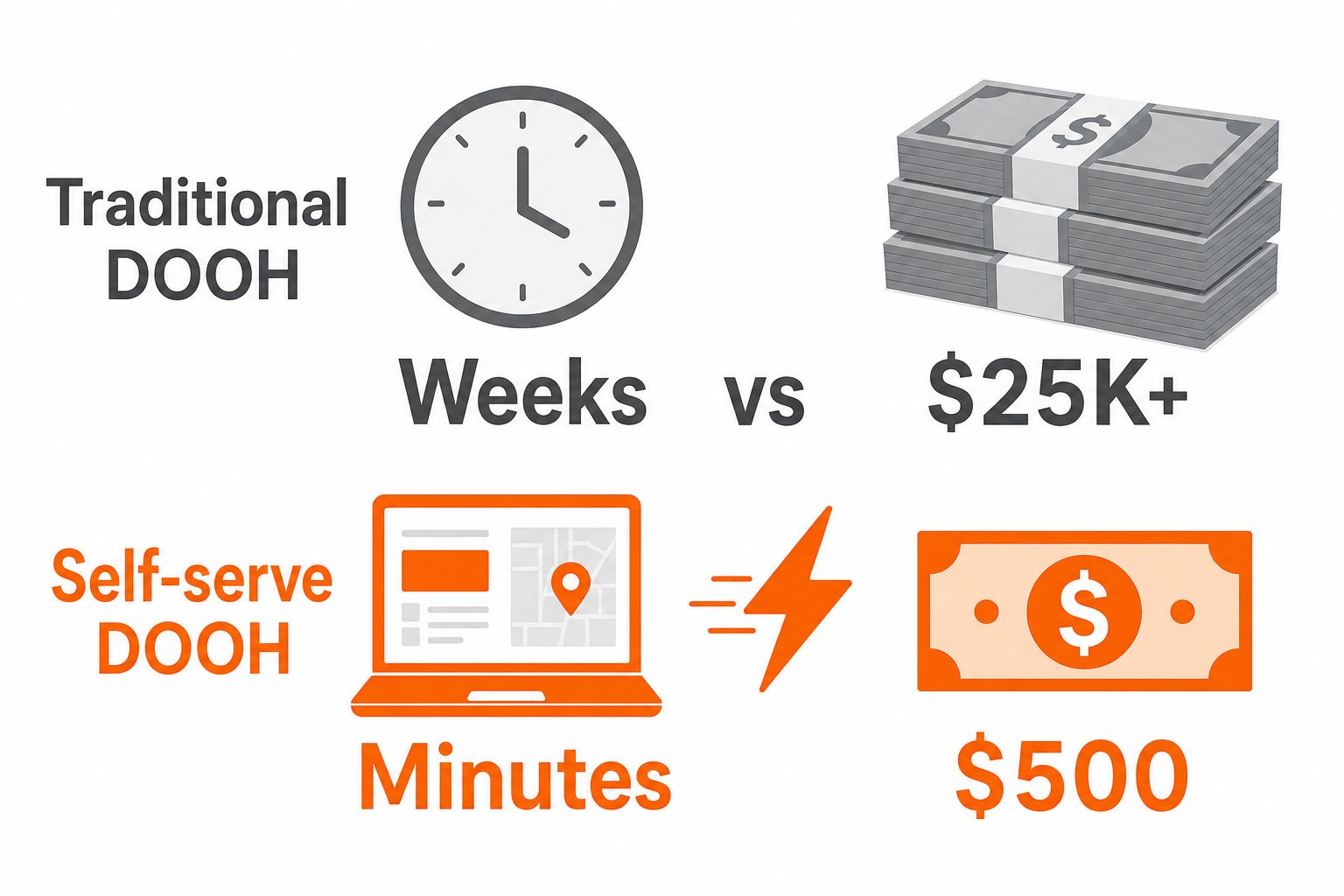
As illustrated above, the transition from manual, broker-led buying to automated, self-serve platforms has unlocked unprecedented flexibility, transparency, and affordability for local businesses.
Highway Billboards vs. Retail Touchpoints: Where Local Brands Win
While digital billboards along major highways are highly visible, they are rarely the most effective choice for local, neighborhood-focused brands. Highway advertising is designed for broad, top-of-funnel brand awareness. It targets fast-moving drivers who have extremely short dwell times (often only 3 to 5 seconds) and are focused on navigating traffic rather than absorbing marketing messages. Furthermore, highway billboards are expensive and lack geographic precision—you are paying to reach commuters who may live miles away from your physical business.
This is where the Take 10 Media self-serve ad network offers a superior alternative. Instead of placing ads on distant highway billboards, Take 10 Media positions high-definition digital screens directly inside local convenience stores and on ATM terminals.
These retail-based DOOH touchpoints offer several distinct advantages for local advertisers:
- Captive Audiences and High Dwell Time: When a customer is standing in line at a convenience store checkout counter or waiting for cash to dispense at an ATM, their dwell time increases dramatically. Instead of a fleeting 3-second glance, your video ad captures their attention for 1 to 3 minutes in a distraction-free environment.
- Point-of-Decision Marketing: Retail screens are positioned at the absolute point of decision—where consumers are holding their wallets, ready to make a purchase. This proximity makes it incredibly easy to trigger impulse buys or direct immediate foot traffic to a nearby business.
- Hyper-Local Relevance: Convenience stores and ATMs serve as hyper-local community hubs. By targeting screens in specific ZIP codes or individual store locations, local service providers and retail brands can ensure that 100% of their ad spend is directed at active, local residents who live and shop in their immediate trade area.
For a deeper dive into selecting the absolute best physical locations for your campaigns, read our guide on where to launch self-serve video ad campaigns.
Comparing Traditional DOOH vs. Programmatic Self-Serve Networks
To fully appreciate the value of modern programmatic networks, let us compare the characteristics of traditional, managed outdoor advertising campaigns against modern self-serve DOOH networks:
| Feature | Traditional Managed DOOH | Programmatic Self-Serve DOOH (Take 10 Media) |
|---|---|---|
| Minimum Budget | High minimums (often $10,000 to $25,000+) | Flexible, accessible micro-budgets (no high minimums) |
| Contract Commitments | Rigid, long-term contracts (weeks or months) | Pay-as-you-go, pause or adjust anytime |
| Buying Process | Manual negotiations, brokers, RFPs, and emails | Instant digital buying via a 24/7 Ad Portal |
| Creative Approvals | Slow, manual reviews taking several days | Automated or rapid digital review (under 24-48 hours) |
| Targeting Precision | Broad, regional bundles with low granularity | Screen-by-screen, ZIP code, or neighborhood selection |
| Performance Analytics | Delayed post-campaign PDF reports with estimates | Real-time, transparent proof-of-play dashboard |
| Creative Flexibility | Static images or highly restricted video changes | Dynamic video creatives, instant updates, A/B testing |
This comparison highlights why local businesses are rapidly shifting their marketing dollars away from traditional offline media and toward self-serve retail networks. To learn more about how this self-directed method compares with traditional managed agency services, check out our comparative analysis of self-serve advertising vs. managed campaigns.
Key DOOH Trends Driving Growth in 2026
As we progress through 2026, several key trends are shaping the future of programmatic digital out-of-home advertising:
1. The Proliferation of Retail Media Networks (RMNs)
Retailers are realizing that their physical stores are highly valuable media assets. By installing digital screens at high-traffic checkout counters and ATM terminals, retailers are creating physical retail media networks. This allows local advertisers to reach shoppers at the exact moment they are making purchasing decisions. To understand how retail screens plug into this wider landscape, explore our analysis of the Self-Serve Retail Media Network trend.
2. Integration of Mobile and DOOH
In 2026, smart marketers are pairing their DOOH campaigns with mobile advertising. For example, a local business can run a high-impact video ad on a convenience store screen and simultaneously run localized mobile display ads targeting users within the same geofence. This multi-channel approach reinforces brand familiarity and drives higher conversion rates.
3. Focus on Creative Optimization
With self-serve platforms, advertisers have complete control over their creative assets. In 2026, the trend is toward short, high-energy, silent-first video creatives. Because retail environments can be busy and noisy, successful ads rely on bold typography, vibrant animations, and clear QR codes to drive engagement without relying on audio. For actionable tips on designing high-conversion creatives, read our guide on how to buy self-serve ads.
How to Get Started with Local DOOH
Launching a local digital out-of-home campaign is no longer a complex, multi-week endeavor. With Take 10 Media’s self-serve platform, you can have your ads running on premium local screens in just a few simple steps:
- Define Your Target Area: Identify the specific neighborhoods, ZIP codes, or convenience store and ATM locations where your ideal customers spend their time.
- Set Your Budget: Establish a comfortable daily or monthly budget that aligns with your marketing goals.
- Upload Your Creative: Prepare a short, visually compelling vertical video (9:16 aspect ratio) featuring a clear call-to-action and a high-contrast design.
- Monitor and Optimize: Use your real-time dashboard to track play counts and impressions. If certain locations are performing exceptionally well, instantly reallocate your budget to maximize your ROI.
By combining the power of programmatic DOOH with the accessibility of self-serve technology, local brands can build powerful, long-term brand awareness right in their own backyards.
Are you ready to claim your space on premium local screens? Explore our advertisers program to learn more, or head directly to the Take 10 Media Ad Portal to launch your first high-impact campaign today. If you are a business owner looking to host screens and earn passive revenue, visit our store owners program or learn how to optimize your business with self-serve advertising for small business.
Frequently asked questions
What is programmatic DOOH and how does it benefit small businesses?▼
Programmatic Digital Out-of-Home (DOOH) refers to the automated buying, selling, and delivery of digital billboard and in-store screen ads. For small businesses, it removes the need for expensive agency brokers, allows for ultra-flexible budgets, and provides real-time control over when and where ads are displayed.
How much budget do I need to start advertising on Take 10 Media's DOOH network?▼
Unlike traditional outdoor media that requires thousands of dollars upfront, Take 10 Media's self-serve platform has no high minimum spend requirements. Local brands can launch targeted campaigns on ATM and convenience store screens with flexible, accessible daily or monthly budgets.
Why are convenience store and ATM screens better than highway billboards for local brands?▼
Highway billboards suffer from extremely low dwell times (3 to 5 seconds) and high speed distraction. Convenience store and ATM screens capture consumers at the point of decision with high dwell times (1 to 3 minutes), zero speed distraction, and direct proximity to purchasing transactions.
How does the self-serve ad portal work for uploading creatives?▼
The Take 10 Media self-serve portal is designed for rapid deployment. Advertisers simply log in, select their target store locations or ZIP codes, set their budget, upload their vertical video creative (such as a 9:16 MP4 file), and submit. Campaigns are typically reviewed and live within 24 to 48 hours.
Can I target specific times of day or specific neighborhoods?▼
Yes. Our programmatic self-serve network allows for precise geographic and temporal targeting. You can select specific convenience stores or ATM terminals in key neighborhoods and schedule your ads to play during peak hours, such as morning coffee rushes or weekend shopping times.
How do I measure the performance of my self-serve DOOH ads?▼
Take 10 Media provides a transparent, real-time analytics dashboard. You can track exact play counts, verified proof-of-play timestamps, active screen status, and estimated impressions, giving you complete clarity on your return on investment.
Ready to launch your campaign?
Reach shoppers at the point of decision with self-serve video ads across 1,500+ premium retail and ATM locations.