
Matched-Market Testing: How to Measure the Real Sales Lift of In-Store Digital Ads
Learn how matched-market testing and IAB measurement concepts help advertisers measure the precise sales lift of in-store digital signage and retail media networks.
Take 10 Media ·
At a Glance
In the digital marketing world, tracking the performance of an advertisement is relatively straightforward: a user clicks an ad, lands on a website, and makes a purchase. In the physical world, however, measuring the direct impact of in-store digital signage and convenience store video ads has historically been a major challenge. How do you prove that a shopper bought a product because they saw an ad on a checkout screen or an ATM terminal? The answer lies in matched-market testing. By adopting Interactive Advertising Bureau (IAB) measurement concepts and leveraging industry-leading frameworks like the Albertsons methodology, advertisers can scientifically isolate and measure the precise incremental sales lift of physical-world ad campaigns.
How to Measure Store-Visit or Sales Lift: The Short Answer
Short answer: set a baseline, compare stores that ran the ads with matched stores that didn’t, and read the result over a fixed window that continues after the flight ends. A plain before/after comparison is the fallback, not the method.
- Baseline period. Pull sales, visits or inquiries for both store groups before the ads start. Four weeks is a practical minimum for a local test.
- Exposed vs. control stores. Run the ads only in the test stores and keep the matched control stores dark. The difference between how much each group changed is your incremental lift.
- Readout window. Keep measuring during the campaign and for a set period after it, because some shoppers buy days after they see the ad. Agree on the window before launch, not after you see the numbers.
One reference point for the windows. IAB Europe’s In-Store Retail Media Definitions and Measurement Standards, Version 2 (a draft for industry review published in September 2026), recommends reporting sales for 28 days pre-exposure, for the duration of the campaign, and 28 days post-exposure, and says retailers should offer flexible windows when brands ask. Version 1 used 30 days. The same draft says before/after “sales variance” should be used only when incremental sales studies are not possible. Treat this as context, not a rule: it is a European draft that was open for public comment until 23 October 2026, it is not final, and it is not a US standard. US retail media networks set their own windows, so ask yours which one it reports.
The Attribution Challenge: Measuring the Physical World
For brands utilizing retail media networks (RMNs) and digital out-of-home (DOOH) screens, traditional digital metrics like click-through rates (CTR) and cost-per-click (CPC) simply do not apply. A shopper standing at a convenience store checkout counter cannot click a physical screen to buy a product; instead, they absorb the visual message and make an immediate or future purchase in-store.
Without a direct digital link between the ad exposure and the transaction, advertisers have often relied on proxy metrics, such as:
- Estimated Foot Traffic: Broad estimates of how many people walked past a screen.
- Coupon Codes: Tracking unique promo codes displayed on screens.
- QR Code Scans: Measuring how many shoppers scanned a code on the ad creative.
While these proxy metrics are useful, they only capture a fraction of the total campaign impact. Many shoppers see an ad, are influenced by it, and buy the product without scanning a QR code or using a coupon. To capture the true value of physical-world advertising, the industry has shifted toward scientific, data-driven attribution models.
To address this need, organizations like the Interactive Advertising Bureau (IAB) have introduced standardized measurement concepts for retail media. These standards focus on proving incrementality—the measure of sales that would not have occurred without the presence of the advertisement.
Demystifying Matched-Market Testing Methodology
Matched-market testing (also known as matched-store testing) is the gold standard for measuring physical-world ad attribution. Rather than trying to track every individual customer’s path to purchase, matched-market testing uses a comparative scientific framework to isolate the direct impact of an advertising campaign.
The methodology operates on a simple yet powerful structure:
- The Test Group: A selection of retail stores or ATM locations where the digital video ads are actively displayed.
- The Control Group: A selection of highly similar stores or ATM locations where the ads are not displayed.
- The Matching Process: To ensure a clean test, stores in the control group must be “matched” to stores in the test group based on critical variables, including historical sales volume, customer demographics, geographic location, and store size.
- The Measurement: Sales of the advertised product or service are tracked across both groups during the campaign period. The difference in sales growth between the test group and the control group represents the incremental sales lift directly attributable to the ads.
Visualizing Sales Lift: The Matched-Market Framework
To better understand how this methodology isolates the true impact of in-store advertising, we can visualize the comparison between test and control markets.
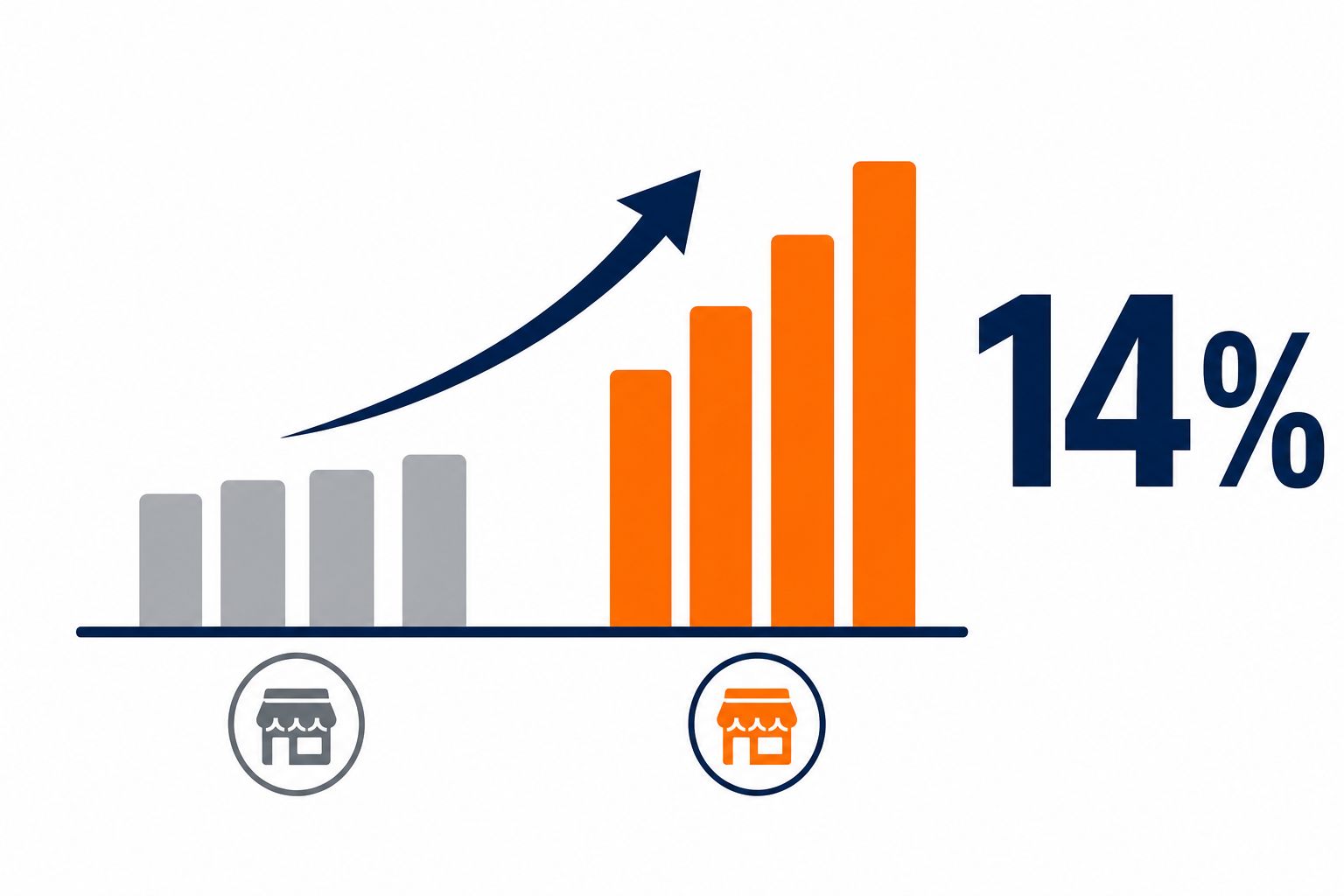
As shown in the infographic, both groups of stores may experience sales fluctuations due to external factors (such as seasonal trends or regional promotions). However, because those external factors affect both groups equally, the difference in performance between the test and control stores isolates the exact incremental lift generated by the digital screens.
The Albertsons Methodology: A Blueprint for Retail Media
In the retail media landscape, Albertsons Media Collective has been a pioneer in standardizing in-store digital ad measurement. Their methodology provides a rigorous, data-science-backed blueprint that other networks and advertisers can replicate.
The Albertsons methodology addresses several key challenges in physical-world ad measurement:
1. Advanced Store Matching
Instead of matching stores based on simple geography, the Albertsons framework uses historical transaction data and machine learning algorithms to pair stores. This ensures that the control stores behave almost identically to the test stores under normal, non-advertising conditions.
2. Isolating Promotional Noise
In retail, products are frequently subject to price discounts, endcap displays, or seasonal promotions. The Albertsons methodology uses statistical modeling to strip out the sales lift caused by these co-occurring promotions, ensuring that the final report only attributes sales to the digital screens themselves.
3. Attribution windows
The framework treats the attribution window as part of the study design. How long after seeing an in-store ad a purchase can still be tied to that exposure depends on the product category, and public descriptions of the Albertsons method do not name one interval.
By bringing this level of scientific rigor to physical-world advertising, the Albertsons methodology gives brands the confidence that their ad spend is driving real, incremental revenue rather than just capturing existing demand.
Comparing Traditional vs. Matched-Market Measurement
To see why matched-market testing is superior to traditional physical-world ad tracking, let us compare the two approaches across several key dimensions:
| Measurement Attribute | Traditional Proxy Tracking (QR/Coupons) | Matched-Market Testing (IAB Standards) |
|---|---|---|
| Primary Metric | Direct action rate (scans, redemptions) | Incremental sales lift and ROAS |
| Capture Rate | Low (only measures active scanners) | 100% of actual store transactions |
| Isolation of Variables | None (vulnerable to seasonal/price noise) | High (fully isolates external factors) |
| Data Source | Third-party scan tools or manual logs | Point-of-sale (POS) transaction data |
| Implementation Effort | Low (requires unique creative assets) | Medium (requires store matching and POS data) |
| IAB Compliance | Low (does not measure true incrementality) | High (fully aligned with industry standards) |
| Actionable Insight | Measures creative engagement | Measures actual business revenue impact |
This comparison demonstrates why sophisticated advertisers demand matched-market testing to justify their retail media investments. While tracking QR code scans is a great way to measure immediate engagement, matched-market testing is the only way to prove the actual financial return on ad spend (ROAS).
To explore how these measurement concepts tie into real-time analytics dashboards, read our article on affordable self-serve ads with real-time performance analytics.
For a look at how out-of-home exposure data is starting to flow into marketing mix modeling and multi-touch attribution tools, see our breakdown of Clear Channel RADAR, LiveRamp, and TransUnion.
Applying Matched-Market Testing to Convenience Store and ATM Ads
While enterprise brands have the resources to run massive, multi-state matched-market tests, local and regional advertisers can apply these same concepts on a smaller, highly practical scale.
By leveraging the Take 10 Media self-serve ad network, local businesses can design and execute their own simplified matched-market tests:
- Step 1: Select Your Test Stores: Choose 3 to 5 convenience stores or ATM locations in a specific neighborhood to display your high-impact video ads.
- Step 2: Identify Your Control Stores: Select 3 to 5 comparable stores in a neighboring area with similar demographics where your ads will not play.
- Step 3: Establish a Baseline: Look at your sales or customer inquiry data from both areas for the 4 weeks leading up to the campaign.
- Step 4: Run the Campaign: Launch your vertical video creative on the selected test screens for a period of 4 to 6 weeks.
- Step 5: Measure the Lift: Compare the sales or inquiry growth in your test neighborhood against the control neighborhood. The difference is your incremental lift!
This localized approach allows small businesses to bring enterprise-level scientific rigor to their local marketing campaigns. By proving the exact sales lift driven by ATM and convenience store screens, local brands can optimize their budgets and maximize their local presence.
To learn more about how to design high-impact vertical video creatives that drive maximum sales lift, check out our guide on point-of-decision marketing and in-store video.
Source for the reporting windows above: IAB Europe, In-Store Retail Media Definitions and Measurement Standards, Version 2: Draft For Industry Review (September 2026), Section 6 “Sales Measurement Metrics”; comment period per IAB Europe, 17 September 2026.
Start Measuring What Matters
Don’t guess whether your offline advertising is working. By embracing matched-market testing and utilizing Take 10 Media’s flexible, transparent self-serve platform, you can gain complete clarity on the real business impact of your campaigns.
Explore our advertisers program to learn how you can target high-traffic retail locations, or log into the Take 10 Media Ad Portal to start planning your next high-impact, measurable campaign. If you are a retail merchant looking to host screens and benefit from in-store advertising, visit our store owners program to learn how digital signage can boost your bottom line.
Frequently asked questions
What is matched-market testing in retail advertising?▼
Matched-market testing (or matched-store testing) is a scientific measurement methodology where advertisers select a group of 'test stores' to run in-store digital ads, and compare their sales performance against a highly similar group of 'control stores' where no ads are shown. This isolates the exact sales lift driven by the advertising campaign.
Why is matched-market testing necessary for physical-world ads?▼
Unlike online advertising, physical-world ads do not have direct click-through rates. Matched-market testing solves this attribution challenge by isolating external variables like seasonality, price changes, and promotions, proving the direct, incremental sales impact of in-store digital signage.
What are the IAB measurement concepts for retail media?▼
The Interactive Advertising Bureau (IAB) has established standards for retail media measurement, focusing on transparency, incremental sales lift, standardized impressions, and rigorous attribution windows. These concepts ensure that advertisers receive verified, audited proof of their campaign's return on investment.
What is the Albertsons methodology for in-store ad measurement?▼
Albertsons Media Collective introduced a standardized framework for in-store digital ad measurement. It uses advanced data science to match test and control stores based on historical sales, customer demographics, and geographic factors, providing a highly accurate and standardized formula for calculating incremental sales lift.
Can local advertisers apply matched-market testing to small-scale campaigns?▼
Yes. By leveraging Take 10 Media's self-serve network, local brands can select a small group of convenience stores or ATMs to run their video ads (test locations) and compare sales or customer inquiries against similar locations where they are not advertising (control locations).
How long should a matched-market test run to get accurate results?▼
For statistically reliable results, we recommend running an in-store digital ad test for at least 4 to 6 weeks. This provides sufficient time to gather baseline data, account for weekly sales fluctuations, and measure sustained customer behavior changes.
How do advertisers establish a baseline to measure local lift?▼
Pull sales, visits or inquiries for both the stores that will show the ads and a matched set of control stores for a fixed period before the campaign starts. IAB Europe's draft Version 2 in-store measurement standard (September 2026, open for comment until 23 October 2026, not final and not a US standard) recommends 28 days pre-exposure. The baseline tells you how the two groups normally move together, so the gap that opens during and after the flight can be read as lift.
How do you measure physical store visit lift?▼
Compare exposed stores or areas with matched control stores that don't run the ads, using the same metric in both (visits, transactions or inquiries). Measure the change from the baseline period to the campaign and post-campaign period in each group; the difference between the two changes is the incremental lift. A plain before/after comparison in the exposed stores alone is weaker, because it can't separate the ads from seasonality or promotions.
Ready to launch your campaign?
Reach shoppers at the point of decision with self-serve video ads across 1,500+ premium retail and ATM locations.