
FEMA IPAWS Alerts on Retail Digital Screens: Benefits for Stores, Shoppers, and Communities
How FEMA’s IPAWS / CAP emergency alerts on convenience store and ATM screens help shoppers, store teams, and retailers—use cases beyond phone WEA alone.
Take 10 Media ·
At a Glance
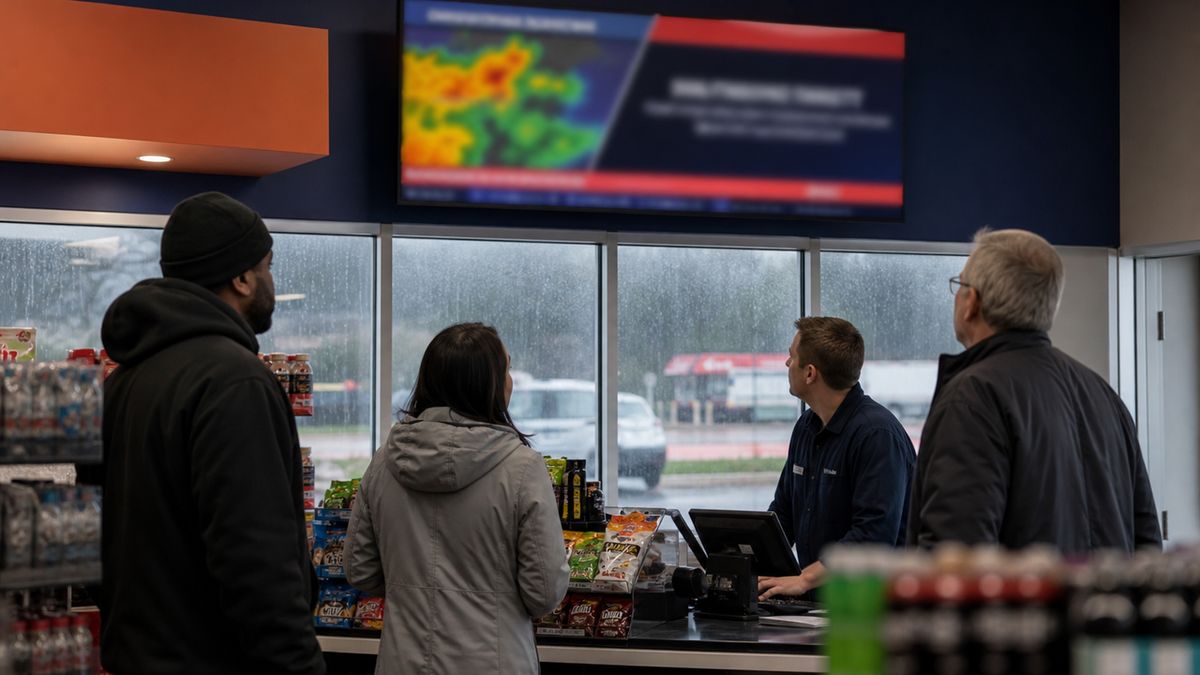
Mobile phones are powerful, but they are not a single-point solution for public safety. Imagine a family walking down a convenience store aisle or a driver at an outdoor ATM. In these moments, personal mobile devices are often tucked away in pockets, left in vehicles, or set to silent. When a sudden tornado warning or critical civil emergency strikes, the buzz of a Wireless Emergency Alert (WEA) might go completely unnoticed.
This is where public-facing digital screens step in as a critical, ambient safety layer. By integrating FEMA’s Integrated Public Alert and Warning System (IPAWS) public feed with retail media networks and ATM displays, store owners and network operators can bridge the gap left by mobile-only alerts. This allows authenticated, geo-targeted public warnings to appear directly in the field of view of shoppers, store staff, and community members. Crucially, this is not an advertising product; rather, it is a responsible use of digital infrastructure that ensures public safety messages take priority when and where they matter most, without commercializing warnings.
Who This Is For
Retail spaces host several audiences who benefit from visible, real-time safety messaging.
| Audience | Why Screens Matter | Ambient Impact |
|---|---|---|
| Shoppers & families | Shared warning when phones are silent or tucked away | Creates immediate, collective awareness in-store |
| Tourists & visitors | No local emergency apps, local radio, or regional alerts | Delivers critical local hazard data without downloads |
| Store clerks & managers | Direct visual cues without checking personal devices | Enables staff to maintain calm and guide customers |
| C-store & ATM hosts | Demonstrates responsibility and builds landlord trust | Positions the venue as a resilient piece of infrastructure |
| Advertisers | Brand-safe preemption; ads yield to public safety | Ensures ads do not run during local crises |
| Communities & EM | Adds a highly visible, redundant pathway beyond WEA | Expands the reach of public safety alerts |
- Families and Shoppers: Parents are often distracted by children, with phones buried or placed on silent. Checkout screen visual alerts provide a shared, immediate cue that everyone in the space can see simultaneously, allowing families to make quick safety decisions.
- Tourists and Visitors: Travelers in high-traffic convenience stores along major highways rarely subscribe to local alert lists. Ambient retail screens provide these visitors with instant, localized emergency information they would otherwise miss entirely.
- Store Clerks and Managers: Retail employees focus on customer service and cannot check personal phones. Official on-screen warnings serve as a direct, authoritative notification for the entire staff, allowing them to execute safety protocols quickly and guide customers calmly.
Benefits by Audience
For Shoppers and Community Members
Ambient screens accelerate hazard awareness when seconds count, delivering critical information to individuals in public spaces.
- Overcoming WEA Gaps: Mobile alerts can be opted out of, silenced, or lose signal inside metal-roofed buildings. Ambient screens act as a vital second channel, catching those who slip through the mobile-only safety net.
- Clear, Shared Information: In a crisis, rumors spread rapidly. Displaying the exact, authenticated text of an official IPAWS alert provides a single source of truth, fostering a coordinated and calm response.
- Enhanced Accessibility and Resilience: Large-format signage offers an accessible alternative for those with hearing or visual impairments. Connected via dedicated broadband, screens can receive alerts even during mobile network congestion.
For Store Teams and Operators
Opting into a public safety-enabled network demonstrates community leadership and builds business resilience.
- Operational Calm and Safety Playbooks: Official alerts help align the entire store. Staff can immediately see the nature of the hazard and execute safety playbooks without checking personal devices.
- A Compelling Host Acquisition Story: Public safety readiness is a major differentiator when pitching to landlords and store owners. Demonstrating that the screen network is “IPAWS-aware” accelerates host acquisition and strengthens partner retention. Store owners can learn more by exploring how venues enable self-serve inventory.
For Retail Media and Advertisers
Advertisers and brand partners benefit significantly from a network that supports emergency preemption.
- Brand-safe preemption: No brand wants ads running adjacent to a local tragedy or active natural disaster. Dynamic preemption can pause or scale back commercial content when configured, protecting brand reputation.
- Strict Separation of Public Safety and Commercial Ads: Official alerts are never treated as a commercial “ad product.” This strict separation maintains the integrity of the emergency message. When alerts expire or are canceled, players are designed to resume normal playlist playback (subject to configuration). Advertisers can manage standard campaigns through the ad portal or learn about campaign structures in our guide on convenience store digital signage advertising.
Real-World Use Cases
The Common Alerting Protocol (CAP) allows digital signage systems to respond to various public safety scenarios.
| Scenario | What Shoppers & Staff Need | Screen Presentation Role |
|---|---|---|
| Severe Thunderstorm / Tornado | Shelter instructions or travel delay warnings | High-visibility layout takeover or fullscreen warning |
| Flash Flood / Winter Storm | Route and timing decisions before leaving | Geo-targeted warning widget on checkout and ATM screens |
| Extreme Heat / Cold | Hydration, shelter, and safety reminders | Persistent lower-severity layout widget or ticker |
| Evacuation / Civil Emergency | Direct instructions to vacate the area | Fullscreen takeover displaying authenticated CAP text |
| AMBER / Missing Person | Eyes up in the community to spot a vehicle | Short, high-attention visual display in high-traffic areas |
| National IPAWS Tests | Verification that the pathway is active | Scheduled, low-disruption test messages to verify ingest |
Industry Precedents in Digital Out-of-Home (DOOH)
Using digital screens for public safety is a growing trend across the digital out-of-home (DOOH) industry. Major billboard networks historically partner with emergency management agencies to display evacuation routes, air-quality warnings, and severe storm advisories. These industry precedents demonstrate how public screens can be mobilized as warning infrastructure. Checkout and ATM screens represent the indoor extension of this public service, meeting shoppers at key points of decision.
How It Works on a Take 10–Style Network (Conceptually)
The Integrated Public Alert and Warning System (IPAWS) operates a public All-Hazards Information Feed. This feed distributes authenticated public safety messages in the standardized Common Alerting Protocol (CAP) XML format. Every alert is digitally signed for authenticity by the originating public safety agency.
Modern digital signage platforms—such as Take 10 Media’s player stack—are built to support CAP/IPAWS-oriented ingest and emergency presentation.
- Ingest & Geo-Filtering: The network’s backend monitors the public CAP feed and filters incoming alerts based on geographic coordinates. A screen in Austin, Texas, will only receive alerts active for its specific county.
- Configurable Presentation & Preemption: Severe alerts can take priority or yield when configured, allowing for a fullscreen takeover that temporarily pauses commercial ad loops. For lower-severity events, the message can be rendered within a dedicated
emergency_alertslayout widget, allowing public safety information to coexist alongside standard content. - Automatic Resumption: When an alert expires or is canceled, the player is designed to resume normal playlist playback (subject to alert priority and configuration).
What This Is Not (Crucial Disclaimers)
To maintain absolute legal and operational clarity, hosts and partners must understand the limits of this technology:
- Not Legal or Emergency Advice: The information in this article, and any emergency alert features supported by digital signage networks, do not constitute legal, regulatory, or official emergency management advice. Store owners must consult with local emergency management authorities to establish their own official safety protocols.
- No Alert Origination: Public feed redistributors and digital signage networks do not originate public safety alerts. They merely redistribute official, publicly available data. Only authorized public safety agencies issue alerts.
- Strictly Non-Commercial: Official public safety alerts must never be used for advertising, marketing, or commercial promotion. They cannot be sponsored, co-branded, or monetized.
- A Complement, Not a Replacement: Retail screen alerts are a redundant, ambient safety channel. They are a complement to, and not a substitute for, official mobile Wireless Emergency Alerts, NOAA weather radios, or direct instructions from first responders.
Next Steps
Hosts who want screens that can support CAP/IPAWS-oriented emergency presentation alongside commercial inventory can start with Take 10 Media’s store owners and ATM operators programs. Advertisers booking routine flights still use the self-serve portal and ad portal—public safety messages are never sold as ads.
Related reading: how venues enable self-serve inventory · Instant Ads QR screen advertising.
Frequently asked questions
How do digital screens display FEMA IPAWS alerts?▼
Retail digital signage can be configured to support CAP/IPAWS-oriented ingest of authenticated public alerts. When an alert matches a screen's geography, the player can present it as a fullscreen takeover or layout widget—exact behavior depends on product configuration and is not a claim that every screen is live-connected today.
Do retail media networks pay to access FEMA emergency feeds?▼
No. The FEMA IPAWS All-Hazards Information Feed is a free public service. However, redistributors must follow FEMA's guidelines, which include obtaining developer credentials, respecting feed polling limits, and ensuring that alerts are never commercialized or used as advertising.
Can emergency warnings on store screens be sponsored by advertisers?▼
No. Official FEMA IPAWS public safety alerts must never be used for advertising, nor can they be sponsored or co-branded by commercial entities. Commercial ads yield or pause entirely to allow authenticated public warnings to take priority, maintaining a strict separation between public safety and commercial messaging.
What happens to active ad campaigns when an emergency alert is triggered?▼
When a highly severe emergency alert is active in a screen's specific geographic area, normal ad playlists can be configured to pause or yield. The screen displays the official public safety message for the duration of the alert. When an alert expires or is canceled, players are designed to return to normal playlist playback; exact behavior depends on alert priority and player configuration.
Why are ATM and checkout screens effective for public safety alerts?▼
ATM and checkout screens capture high-intent, close-up attention at key points of decision. Because shoppers are already looking directly at these displays during transactions, they provide an ambient, highly visible channel that bypasses silent phones, cellular congestion, and physical distractions.
Does displaying emergency alerts require a special store owner license?▼
Store owners typically do not need a separate emergency-management license to host screens that can redistribute public IPAWS/CAP information. Technical ingest and geo-filtering are network/provider capabilities when enabled. This is not legal advice—confirm local requirements with counsel or emergency managers.
Is a digital screen alert a substitute for mobile Wireless Emergency Alerts?▼
No. Digital signage alerts are a vital complement to, not a substitute for, mobile Wireless Emergency Alerts (WEA), NOAA weather radios, or official instructions from first responders. They provide an additional ambient safety channel to reach people who may have silenced their phones or left them in vehicles.
Ready to launch your campaign?
Reach shoppers at the point of decision with self-serve video ads across 1,500+ premium retail and ATM locations.